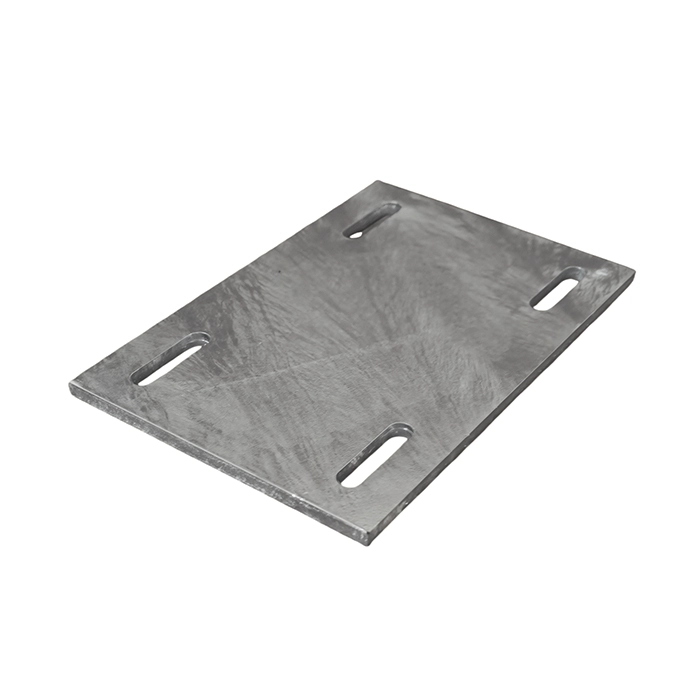

Why the Steel Grade Decision Comes First
Every specification argument about a curtain wall component — coating, tolerance, price — sits downstream of one earlier decision: which steel grade the part is made from. The grade fixes the minimum yield strength, the weldability, and how the part behaves when it is bent, punched, and galvanized. Choose it late, and the drawing set usually has to be redrawn.
For curtain wall steelwork, two Chinese national-standard grades account for the large majority of production: Q235B and Q355B. A smaller share of projects needs stainless steel, or a weathering grade for exposed architectural steel. This article explains what separates them in practice.
What the Grade Codes Actually Mean
The Q stands for the Chinese term for yield. The number is the minimum yield strength in megapascals at a 16 mm thickness. The letter suffix is the quality class, which governs the impact toughness test temperature and the permissible sulphur and phosphorus content.
| Grade | Min. yield strength | Tensile range | Impact test | Typical use in facade work |
|---|---|---|---|---|
| Q235B | 235 MPa | 370–500 MPa | +20 °C | Embedded plates, brackets, non-critical welded assemblies |
| Q355B | 355 MPa | 470–630 MPa | +20 °C | High-load adapters, long-span brackets, heavily loaded inserts |
| Q355C / Q355D | 355 MPa | 470–630 MPa | 0 °C / −20 °C | Cold-climate projects, thick sections, dynamic loading |
| Q355NH | 355 MPa | 470–630 MPa | +20 °C | Exposed architectural steel where the patina is acceptable |
| 304 / 316 stainless | 205 MPa | 520 MPa min. | — | Coastal, marine, chemical or high-humidity environments |
Two points are routinely missed. First, the yield strength figure is quoted for a specific thickness band — a 40 mm plate is not held to the same number as a 12 mm plate, so thick-section designs must be checked against the correct band in the standard. Second, the quality class letter is not a strength statement. Q235B and Q235A have the same strength; the B class simply guarantees a room-temperature impact test and tighter chemistry, which is why structural work almost always specifies B or better.
Q235B or Q355B: The Practical Trade-off
The instinct is that the stronger grade is the safer choice. In curtain wall work the more useful question is whether the extra strength actually gets used, because strength only pays for itself when the part is loaded near its limit.
| Consideration | Q235B | Q355B |
|---|---|---|
| Load capacity for the same section | Baseline | Roughly 50 % higher yield |
| Plate thickness needed for a given load | Thicker or more ribs | Thinner section, lighter part |
| Weldability | Very forgiving, low carbon equivalent | Good, but heat input needs more control on thick sections |
| Formability in bending and punching | Easier, less springback | Higher springback, tighter tooling control |
| Cost per tonne | Lower | Higher |
| Common in embedded parts | Standard choice | Used when embedment depth is restricted |
The clearest case for Q355B is a constraint that is not about strength at all: when the embedded plate cannot be made thicker because the slab cover, the formwork depth, or the anchor layout will not allow it. A thinner Q355B plate can then carry the same load in less space. The clearest case for Q235B is a welded assembly with many plates, where the lower carbon equivalent keeps distortion predictable and welding cost down.
If the design load calculation forces you into grade selection, it is worth having the structural engineer state whether the limit is stress or deflection. A part governed by deflection gains nothing from a higher-strength grade, because stiffness depends on the section geometry rather than the yield point.
When Neither Carbon Grade Is Enough
Three situations push specification away from plain carbon steel:
- Coastal or marine exposure. Salt spray attacks a zinc coating from the outside in, and any coating damage becomes a corrosion cell. Where maintenance access is difficult — high-rise, atrium, or concealed anchor zones — stainless steel or a duplex grade is often cheaper over the service life than repeated recoating.
- Chemical or industrial atmospheres. Effluent plants, chemical storage facilities, and some industrial parks carry airborne chlorides or acids that consume a galvanized layer far faster than the standard corrosion tables assume.
- Architecturally exposed steel. Where the steel is deliberately left visible, a weathering grade lets the surface develop a stable patina instead of being painted or galvanized. This is a design decision, not a corrosion decision, and it needs to be agreed with the architect before fabrication.
Specifying the Grade on the Drawing
A grade call-out that survives contact with the factory includes more than three characters. A workable specification states:
- The grade and quality class, plus the governing standard and edition.
- The product form — plate, hot-rolled section, hollow section, or bar — and the thickness range it applies to.
- The impact test requirement where the service temperature is low.
- Whether mill certificates and, for critical parts, third-party test reports are required.
- The surface condition and any pre-treatment before coating.
Where a part is custom-made to your drawings, it also helps to state which dimensions are critical to fit-up and which are free. That single distinction prevents most of the arguments that otherwise surface at the first delivery. Our guide to tolerances and dimensional inspection covers how to express that on a drawing set.
How Material Choice Connects to Coating
Grade and coating are usually decided by different people at different times, which is why they drift out of step. The pairing that works:
| Exposure | Recommended grade | Recommended protection |
|---|---|---|
| Interior, dry, concealed | Q235B | Electro-galvanized or primer |
| Exterior, general climate | Q235B or Q355B | Hot-dip galvanized |
| Coastal within 1 km of shore | Q355B minimum | Hot-dip galvanized with increased coating weight, or stainless |
| Direct salt spray or immersion | 316 stainless | Uncoated, passivated |
| Exposed architectural steel | Q355NH | Uncoated weathering surface |
The comparison between the two common zinc methods is set out separately in our article on hot-dip versus electro-galvanized embedded parts.
One Step Earlier in the Chain
Grade selection is the first link in a chain that runs through fabrication, coating, packing and installation. Manufacturers who cut, bend and weld in-house control more of that chain than the grade decision alone suggests, because the same team that reads the grade call-out also controls the heat input, the bend radius and the hole positions. If you want to see how that translates into finished parts, the embedded parts range and the precision steel parts range show the range of geometries produced from these two grades.
For orders built to your own drawings, send the drawing set together with the load case and the exposure category. With those three inputs the grade, section and coating can be fixed in one pass instead of three. See more product knowledge articles or our manufacturing capability for the equipment behind these decisions.